Mutualism: Organized Neighborly Help
Not “Mutualism” in any particular academic or political sense — just neighbors helping neighbors, organized well enough that the help actually lands. An emerging tactic worth prototyping alongside the other Three-Prong ideas.
The idea in one paragraph
A teacher’s paycheck isn’t the only thing that shapes how much money they keep. If the community can quietly absorb some of their recurring non-school costs — through organized, non-threatening, tax-deductible structures — that’s functionally the same as a raise, without any of the political or budget implications of an actual raise. Do it well and it helps the teacher, gives donors something concrete to support, lets a local business serve the community efficiently, and gives the union a real reason to meet the district halfway on short-term wage restraint. A small idea, but it compounds.
A simple example: Lawncare
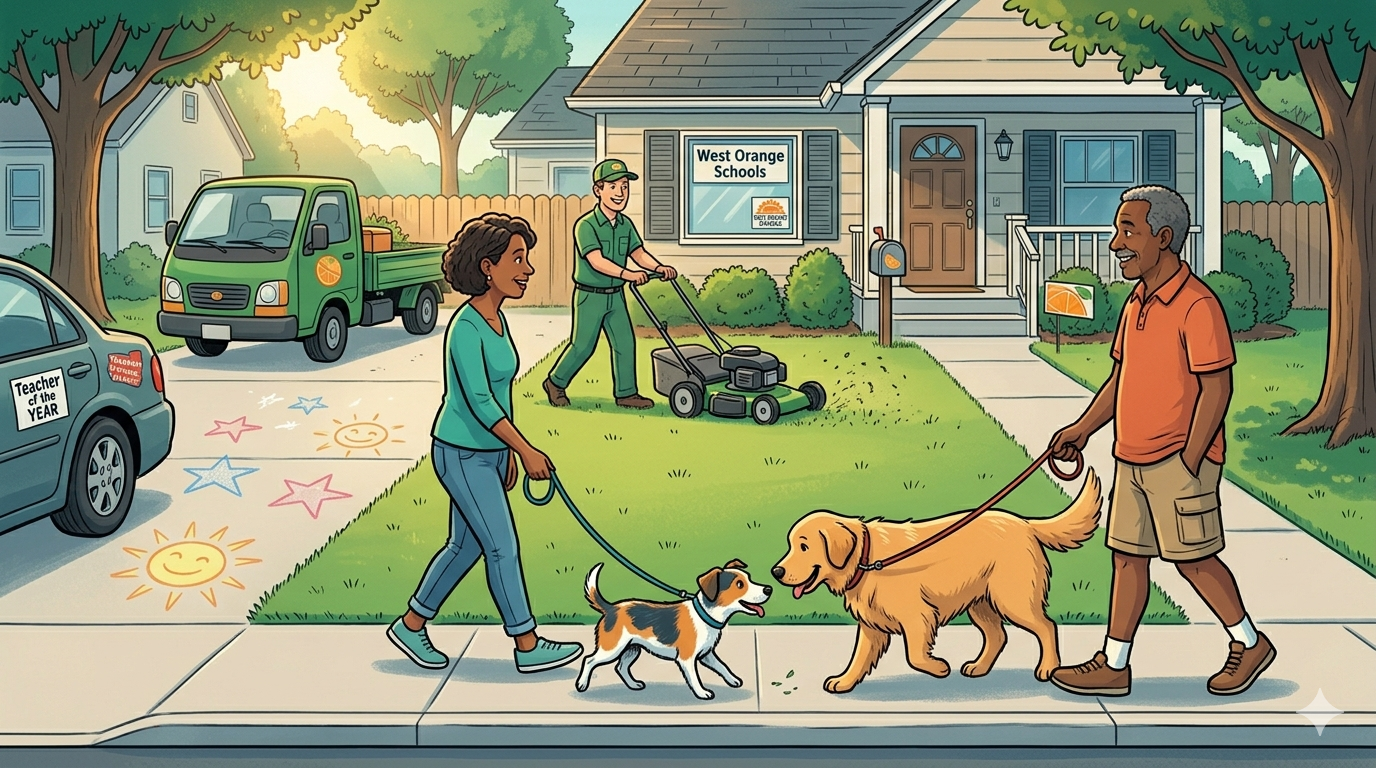
Consider an older teacher with health issues who pays about $100/month for lawn maintenance — roughly $1,200/year they’re spending just to keep their yard in shape. They’d do it themselves if they could. They can’t.
One answer is the one-on-one version: a neighbor notices, reaches out, and either pays for the service directly or does the work themselves. That’s lovely when it happens, but it depends on a neighbor happening to know, happening to ask, and the teacher happening to feel comfortable accepting. Most of the time that chain doesn’t line up, and the teacher keeps paying.
The organized version swaps the serendipity for structure:
- The PTA (a 501(c)(3) non-profit) creates a small “Teacher Support” sub-fund — ideally on a transparent platform like OpenCollective, so every dollar in and out is visible.
- Neighbors who want to help donate to the fund. Because it’s going through a non-profit, donations are tax-deductible.
- The PTA collects a list of teachers who’ve opted in as beneficiaries — identifying themselves to the PTA, not publicly.
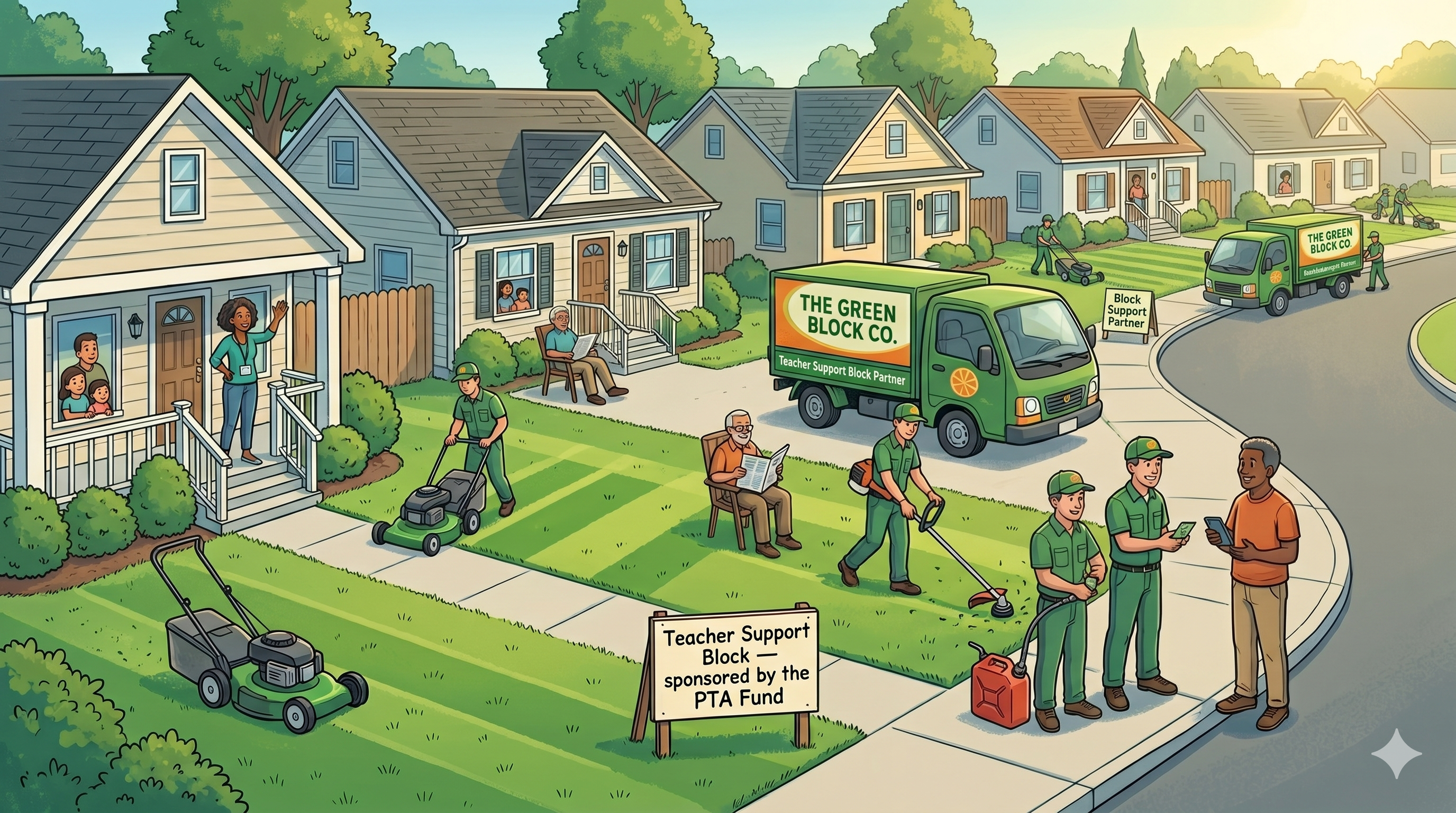
- The fund aggregates the work geographically: a block of ten to twenty participating homes in the same neighborhood gets packaged as a single lawncare contract.
- A local lawncare firm bids on the block. Because the firm can service all twenty houses on one trip — without moving the truck more than a few minutes — they can offer a meaningfully reduced price. They may offer an additional discount because the work is routed through a community non-profit and has local-reputation value attached.
- The teacher pays nothing. The fund pays the firm. The donors deducted their gifts.
The teacher keeps $1,200/year of what was going out the door. Nobody’s pay changed. No line item appeared on the school budget. No red tape had to be snipped.
The four-way win
| Who | What they get |
|---|---|
| Teacher | ~$1,200/year in take-home equivalent, no awkwardness, dignified. |
| Donor | Tax-deductible giving with a tangible local outcome they can point to. |
| Local firm | Efficient bulk work, steady cash flow, community goodwill — a meaningful customer. |
| Union / district | A real-world channel for “our members are being supported” that isn’t a wage negotiation. |
The last cell is politically important. Part of what makes the Prong 1 union sacrifice hard is that asking for restraint feels like asking people to accept less, period. If some of the erosion in take-home is being offset by organized neighborly help, restraint becomes more defensible — both to the negotiating union and to the members themselves.
This is the key distinction from the cost-cutting ideas elsewhere in the whitepaper: mutualism doesn’t replace school work. It doesn’t step on any union toe, doesn’t outsource any teaching function, and doesn’t reduce any salary. It’s purely additive — outside-work help that happens to make inside-work compensation go further.
Other services this pattern could absorb
Lawncare is a particularly clean example because the geographic aggregation savings are obvious. But the pattern generalizes to any recurring, locally-provided service where a firm can be more efficient when serving a block rather than a scattered set of individual customers. Candidates worth thinking about:
- Snow removal. Same seasonal / geographic logic as lawncare. In New Jersey, an especially expensive winter pain point for older teachers.
- Minor home repairs. A pool of pre-vetted local handypeople taking on small jobs — gutter cleaning, weatherstripping, replacing a leaking faucet, all coordinated to service one block at a time.
- Meal trains during family emergencies. Low-cost to organize, high-value to the recipient.
- Pet care and small-animal needs. Dog walks, sit-ins during long school days.
- Grocery or pharmacy delivery for teachers with health or mobility constraints.
- Transportation support. A teacher who’s had to give up a car can be served by a shared-driver rotation or subsidized rideshare credits for school-related trips.
- Summer enrichment swaps. Teachers’ own kids getting camp scholarships or tutoring swaps from other local teachers and parents during the unpaid summer gap.
Each is small; together, a handful at $50-$200/month each can add up to meaningful help, without ever touching a salary line.
How to start small
This is the kind of idea that dies if you try to launch all at once and succeeds if you pilot a single narrow version and then grow it:
- Pick one service type. Yard care is a nice starter, with geographically-obvious savings and a common paid service.
- Find teachers who’d participate. Keep it quiet and dignified. The PTA can ask; teachers can opt in privately.
- Find volunteers willing to donate money or time. Match them geographically to the beneficiary homes if possible.
- Set up the sub-fund through the PTA’s existing 501(c)(3) (or via OpenCollective if they haven’t set one up yet). Only needed if not using volunteers with spare time.
- Run the pilot one season. Document what worked, what broke, what the teachers and donors said.
- Report publicly (with teacher privacy preserved) on the outcomes — dollars moved, services delivered, satisfaction.
- Expand. Second service type. Or second neighborhood. Or both.
The point of starting small isn’t modesty for its own sake — it’s that trust infrastructure is exactly the thing that takes practice to build, and small pilots let you build it without much risk if you get something wrong.
Honest drawbacks
Same-as-always with this kind of civic invention: worth being upfront about the trade-offs.
- Privacy is a real challenge. Nobody should be publicly labeled as “the teacher who needed help.” Matching must be confidential, and public reporting has to be about outcomes, not individuals.
- Some teachers will decline on principle — the “I don’t accept charity” response is common and deserves respect. The opt-in has to be private, genuinely optional, and never nagged.
- Matching logistics need to scale. At 5 teachers this runs on a spreadsheet and goodwill; at 50 it needs more of a dedicated platform - which is entirely doable with modern tools and volunteers.
- Liability questions are real. If a community-contracted lawncare firm damages a teacher’s property, who’s on the hook? The firm’s own insurance usually, but contracts need to be written so the PTA isn’t absorbing surprise liability.
- Not a salary replacement, and shouldn’t try to be. The point is to help teachers keep more of what they earn, not to substitute for fair pay. The moment this is framed as “we’re supporting teachers instead of raising salaries” it becomes toxic. The framing needs to stay “in addition to fair compensation.”
- Concentration risk. If one well-meaning donor family funds most of the pilot, the fund’s survival depends on their continued willingness. Breadth of contribution matters even at small scale.
- Equity across teachers. If only some teachers opt in, or only some benefit, the ones left out may notice. Clear criteria and ample communication matter.
- Union optics need care. Presented well, this reinforces union interests (members keeping more money, organized support infrastructure). Presented badly, it reads as “the community is doing what the employer should be doing.” The union should be brought in early and invited to co-shape it, not surprised by it.
None of these drawbacks are reasons not to try. They’re reasons to start narrow, stay transparent, and treat the first season as a prototype.
How this connects to the rest of the whitepaper
- Sponsor a Neighbor (Tax Math) is the 1:1 informal version of this idea — direct person-to-person cash transfer to cover a tax increase. Mutualism is the organized, aggregated, ongoing-service version. Both are useful; they solve different problems.
- The PTA as Community Operating System is the infrastructure this runs on. Without a visible non-profit fund that donors can see into, this idea stays informal and small. With one, it can scale.
- Community Sports is another example of the same three-way pattern: community organization + district workforce + local service provider, all meeting in a non-profit arrangement.
- The Time Economy is the philosophical context. If you accept that much of what we pay for is overhead accumulated between producer and consumer, then organizing community purchasing to cut that overhead is precisely the practical move the thinking points to.
- The Virtuous Spiral is the effect compound-in-action. A teacher saving $100/month is not a school budget win per se. But a teacher saving $100/month is measurably less likely to leave the profession, which is a school budget win in disguise, because teacher retention is the single most expensive variable the district has.
A final note
This is explicitly an unfinished idea. It’s offered here as prototype thinking, not a proposal ready for board action. If it resonates with you — if you’d be interested in donating to a pilot, or helping coordinate one, or you’re a teacher who’d be willing to be in the first opt-in cohort — reach out: volunteer@frontstate.org.
If enough people find this compelling to actually try, we’ll upgrade it from an appendix page to a full module with real coordination infrastructure and a named fund.
| Back to: The Bigger Picture | Tax Math | The Time Economy |