Tax Math: What a School Tax Increase Actually Costs
Heads up — these numbers are community math, not official. The calculations on this page come from a screenshot circulating in local PTA channels. The math itself is internally consistent, but several of the inputs — the 67/33 school-vs-municipal split, the 7.26% municipal figure, the 6.5% and 9% alternative school scenarios — are community-attributed and have not been confirmed against district or township records. That’s a problem this page exists to illustrate as much as solve. See What’s verified vs. unverified below.
The core insight
Many people hear “2.5% school tax increase” and read it as “my taxes are going up 2.5%.” That’s not how property tax math works in NJ. The 2.5% applies only to the school portion of your tax bill. And in West Orange, schools are roughly 67% of your property tax while municipal is roughly 33% (with the Essex County portion typically folded into one or the other, or treated separately — see below).
So a 2.5% school increase combined with a 7.26% municipal increase doesn’t become “9.76% higher taxes.” It becomes a weighted average across the two portions — and the weighted number is smaller than either component.
Three scenarios
All three use the same formula:
Blended increase = (school % × school share of bill) + (municipal % × municipal share of bill)
Using the community-circulating 67% school / 33% municipal split:
Version 1 — Current proposal
| School | Municipal | Blended increase |
|---|---|---|
| 2.5% | 7.26% | 4.07% |
Worked out: (0.025 × 0.67) + (0.0726 × 0.33) = 0.01675 + 0.02396 = 0.04071 → 4.07%
On a $16,000 annual property tax bill: +$651/year (≈ $54/month, ≈ $1.80/day).
Version 2 — A figure mentioned at the Monday BOE meeting
| School | Municipal | Blended increase |
|---|---|---|
| 6.5% | 7.26% | 6.75% |
On a $16,000 bill: +$1,080/year (≈ $90/month, ≈ $3/day).
Version 3 — What it would take to fully cover healthcare increases
This is the purported possible increase of the school tax that would be needed if the district tried to absorb the full healthcare premium increase without cuts, borrowing, or external offsets.
| School | Municipal | Blended increase |
|---|---|---|
| 9% | 7.26% | 8.43% |
On a $16,000 bill: +$1,349/year (≈ $112/month, ≈ $3.70/day).
Run the numbers on your own bill
The daily-dollar framing shifts depending on your actual tax bill. To plug in your own number:
- Find your total annual property tax (on your tax bill, or look it up at tax.munidex.info/westorange-nj-0722 — search by name + address, includes historical assessments and taxes by year).
- Multiply by the blended increase percentage above (e.g., 4.07% → × 0.0407).
- Divide by 365 for a daily figure, or 12 for monthly.
So on a $12,000 bill under Version 1: $12,000 × 0.0407 = $488/year ≈ $1.34/day. On a $24,000 bill: $24,000 × 0.0407 = $977/year ≈ $2.68/day.
What’s verified vs. unverified
What the math correctly computes, given the inputs:
- ✅ The blended-percentage formula itself is sound
- ✅ Each row’s arithmetic checks out
- ✅ The core insight — that a 2.5% school increase does not equal a 2.5% increase on your total bill — is structurally correct
What is community-attributed and should be confirmed against primary sources:
- ❓ The 67% / 33% school / municipal split. In NJ, most residential property tax bills are divided among three layers: school, municipal, and county (Essex County, in our case). The county portion is often 10–20% of the total. A clean 67/33 treatment either folds county into municipal, omits it, or is a simplification. The actual three-way split for West Orange should be in the current tax rate tables — but we don’t have that primary source linked here.
- ❓ The 7.26% municipal increase. No primary township budget link accompanies this figure in the screenshot.
- ❓ The 6.5% and 9% school scenarios. Attributed verbally to the April 21 BOE meeting and Mr. Stevenson respectively. No meeting minutes or slides linked.
- ❓ The $16,000 baseline is an illustrative example, not a West Orange median. Your bill could be meaningfully higher or lower.
This is exactly the kind of information that should live in an official, citable place — ideally a district or township page with current-year numbers and downloadable source documents. Which is part of why we propose an Open Budget & Participatory Finance module and Open Governance practices. A screenshot in a PTA group chat shouldn’t be load-bearing civic infrastructure.
A few sites and sources usually exist with public information, but they are sporadic and not always very clear or complete.
Sponsor a Neighbor
Every scenario above has the same problem: a flat tax increase hits residents very unevenly. A dual-income household and a retiree on fixed income pay the same percentage increase even though the burden is radically different.
One answer is to strengthen existing NJ relief programs (Senior Freeze, Homestead/ANCHOR) through better outreach — many eligible residents never enroll. But those are bureaucratic and slow. Another answer, which the community can start today, is informal:
Sponsor a neighbor. If you can comfortably absorb a few hundred dollars a year, you offer to cover the increase for a household that can’t. No government forms, no means-testing paperwork, no tax code changes — just neighbors helping neighbors, organized through the PTA, a local faith community, or a simple shared list. For the organized-service cousin of this idea — where community donations fund ongoing things like lawncare or snow removal for teachers — see the Mutualism appendix.
I (the site author) would be happy to cover several local residents if needed, and I’d help build the coordination layer to organize it more broadly — a lightweight way to match households who want to sponsor with households who need sponsorship, with appropriate privacy.
Why informal, and the trade-offs
Going community-to-community rather than through the tax process itself has real advantages:
- No red tape. We don’t need statutory authority, a dedicated line item, or approval from multiple layers of government to help a neighbor.
- Fast. It can start organizing this year. This month. This week.
- Flexible. The definition of “needs help” can be set by the people actually involved, not by an eligibility threshold set in Trenton in 1998.
- Reinforces community trust. The point isn’t just the money — it’s the visible fact that neighbors are showing up for each other.
And the honest drawbacks:
- Not tax-deductible the way a qualified charitable contribution might be. (Though some structures — a fiscal sponsor, a 501(c)(3), a PTA as community OS collective — could make donations deductible if the effort grows.)
- Not scalable to everyone. Informal sponsorship helps a handful of neighbors, not thousands. For broader equity, the formal relief programs and ultimately state-level funding formula reform still matter.
- No guarantees. A sponsor who loses their job next year can’t be compelled to keep covering someone. The structure is a handshake, not a contract — which is a feature for speed and a limitation for durability.
- Privacy considerations. Matching sponsors with recipients needs care. Nobody should feel publicly identified as “the neighbor who needed help.”
None of these trade-offs are reasons not to start. They’re reasons to think through the structure as we go, and to treat this as a complement to — not a replacement for — formal relief programs and state-level advocacy.
How to get involved
It is too early to outright volunteer to cover a tax we don’t know the details of yet. But we could still discuss and organize. Anybody interested in helping organize the matching logistics — reach out: volunteer@frontstate.org or submit an issue to the GitHub repo
How to get official numbers
If you want to confirm (or correct) any figure on this page against primary sources, the starting points are:
- The district budget. The BOE’s User-Friendly Budget and annual comprehensive financial report should contain the school tax levy, the proposed rate, and the effective tax rate per $100 of assessed value.
- The township tax rate table. The municipal clerk / tax assessor’s office publishes the split among school, municipal, and county portions.
- Essex County budget. For the county portion specifically.
- BOE meeting minutes and slides. The April 21, 2026 meeting in particular, for the 6.5% and 9% figures attributed verbally.
If anyone reading this has links to those primary sources, please file an issue and we’ll cite them here and remove the “❓” marks above.
As of this writing (2026-04-23) the minutes from the prior Monday BoE meeting have not yet been posted.
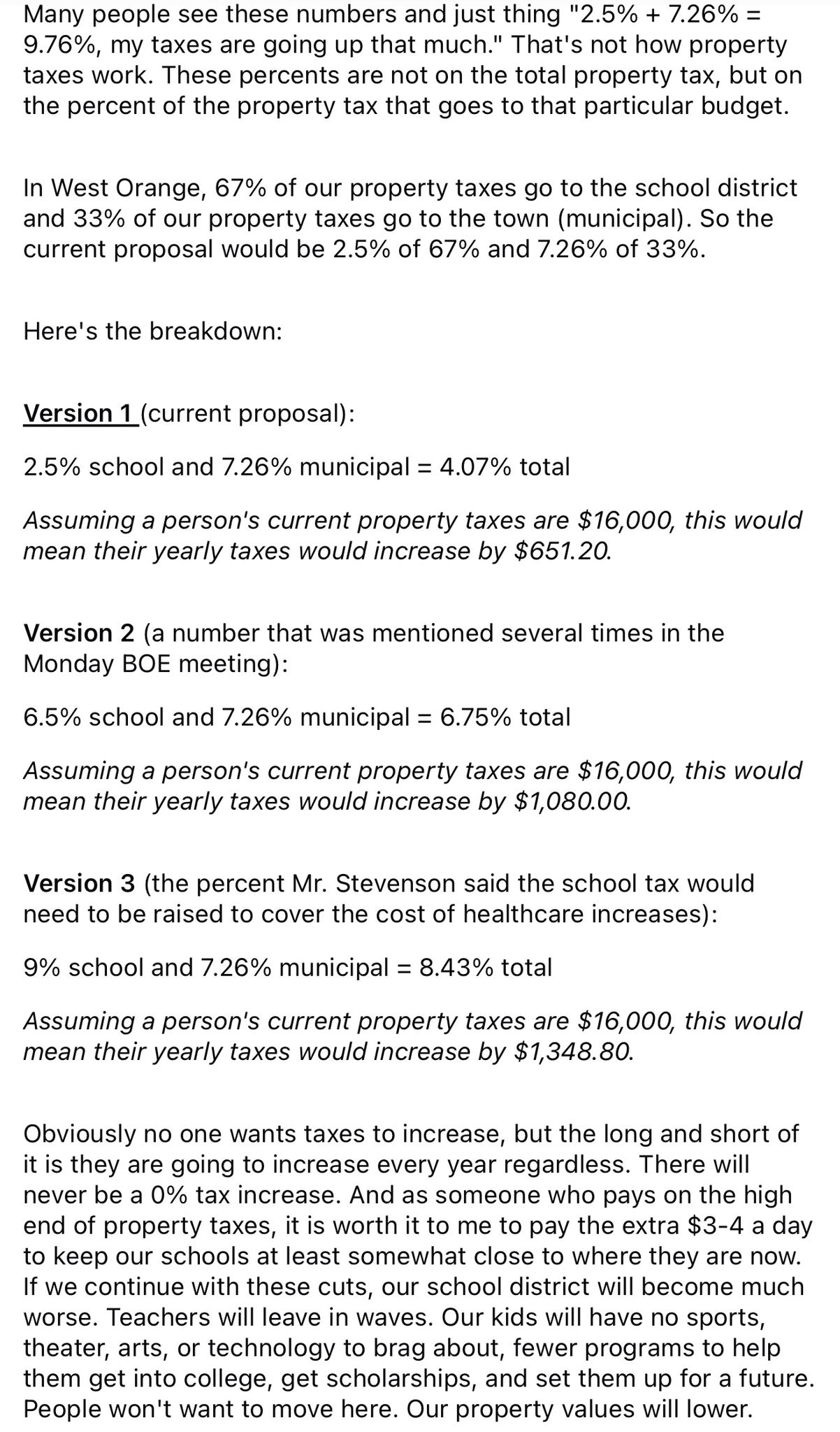
Source screenshot
The community math on this page comes from this screenshot, shared via a West Orange PTA channel. Author unattributed.
Related:
- The Action Plan — Prong 1 for where the “sponsor a neighbor” idea fits in the broader strategy.
- Open Budget & Participatory Finance for the infrastructure that would make this kind of math officially citable.
- Open Governance for the process changes that would mean BOE meeting figures are captured and sourceable rather than relayed through screenshots.