What the District Said
The district’s own statements about the outsourcing, set beside what the records show. The second part of each section fills in as records arrive; until then it says which request asks for them.
The quoted statements in the first four sections come from the Superintendent’s community budget letter of April 29, 2026. The last section quotes the Board negotiations committee’s email to families of October 14, 2026.
The savings
“…a substantial $3 million savings that will reoccur year after year.” (p. 3)
“…outsourcing our paras is a vital $3 million annual recurring savings…” (p. 4)
What the records show so far. No calculation behind the $3 million figure has been published. OPRA-001, item 7, asks for it.
Separately, on July 21, 2026 the Board approved an “EduStaff Pricing Schedule Addendum-Exhibit B for an estimated amount of $12,000,000” (minutes, p. 13). The minutes do not say what the addendum covers. A contract’s cost and a savings figure are different things, so the two numbers cannot be read against each other until the calculation and the agreement are public.
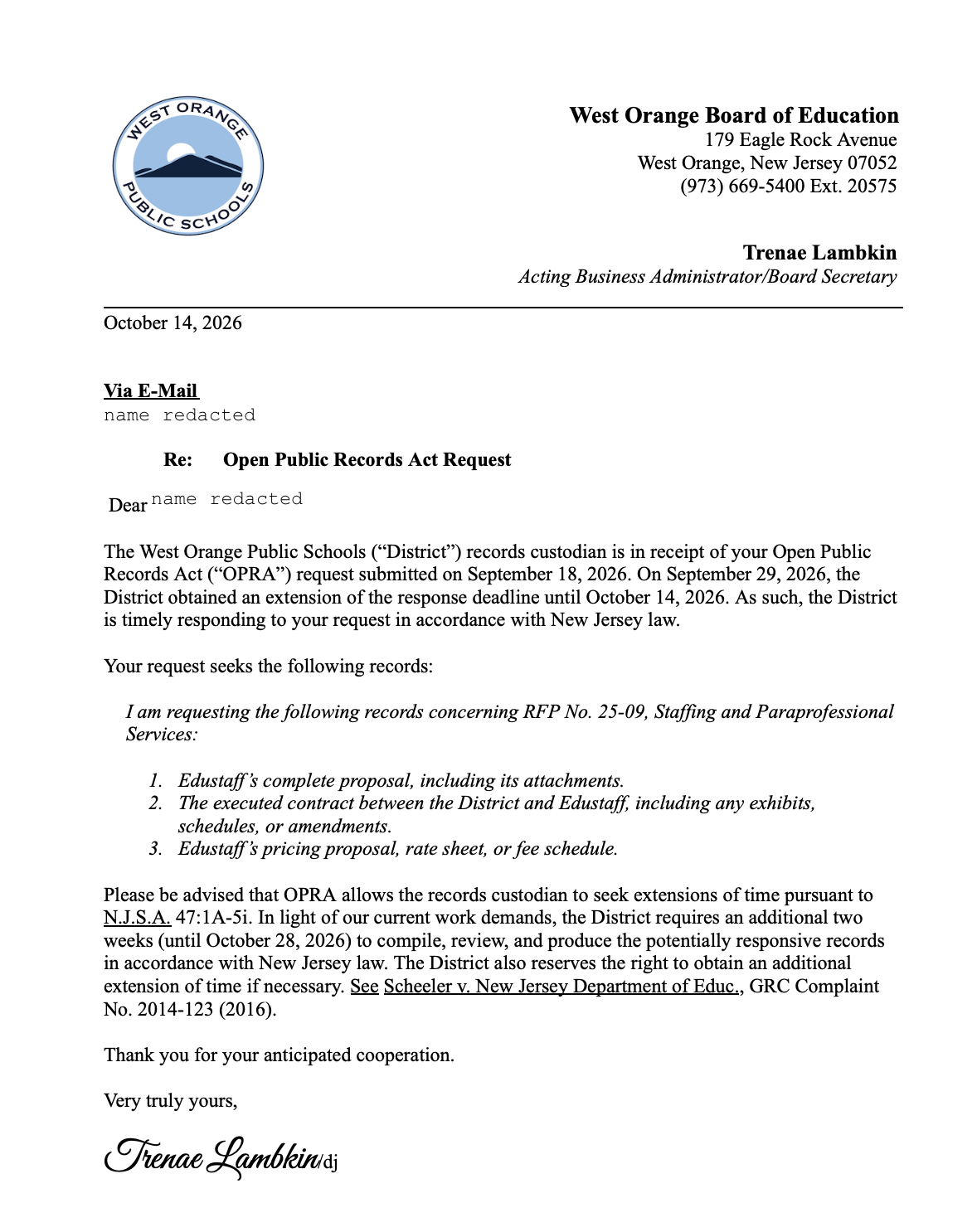
One EduStaff agreement is public: the district’s 2022 master agreement, released under OPRA in July 2025, priced substitute staff at “30.00% of Staff Gross Payroll” in an exhibit titled “Edustaff Pricing Schedule” (Exhibit B), and ran to June 30, 2024 with extensions by addendum. Whether the 2026 “Pricing Schedule Addendum-Exhibit B” amends that agreement, prices paraprofessionals the same way, and at what wage, is what OPRA-001, item 1, will show. Another resident asked for EduStaff’s proposal, contract, and pricing on September 18; the district has twice taken two more weeks, most recently on October 14 “in light of our current work demands”, and now says October 28 (custodian’s letter).
The same people
“While the employer of record may change, the people do not — our students will continue to see the same familiar faces they rely on.” (p. 3)
What the district has said since. At the September 28, 2026 Board meeting the Director of Human Resources reported 176 paraprofessionals working against 244 positions needed: 47 returning, 13 in grant-funded or pension positions, and 116 new (recording, from 53:12; figures from the automatic captions).
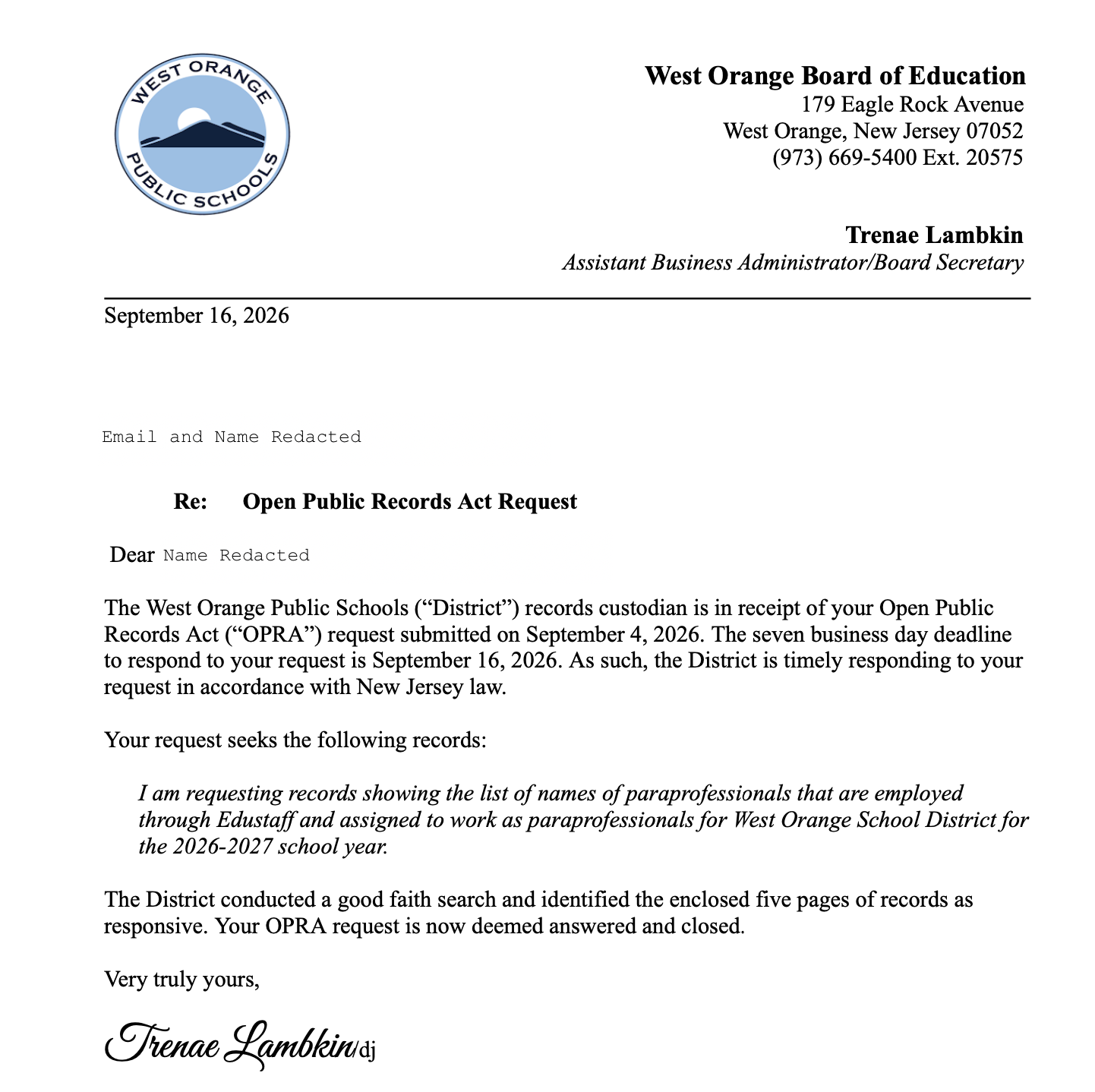
What the records show so far. A list the district released to another resident on September 16, 2026, in answer to a request for the paraprofessionals employed through EduStaff for 2026-27, names 145 people: 132 marked “Edustaff” and 13 marked “Employed by West Orange” (custodian’s letter; the list with names removed). The 13 matches the number the district gave on September 28 for grant-funded and pension positions. The list does not say who returned from last year and who is new, which is what the “same familiar faces” claim turns on, and it is 31 short of the 176 the district reported working twelve days later. OPRA-002 asks for the positions filled and vacant by building, and for any written version of the September 28 report.
Consistency
“…there will be no rotation of paras as most paras are IEP driven. The administration and I will demand consistency for our students receiving special services.” (p. 4)
What the district has said since. At the same September 28 meeting the district reported 24 vacant positions and 44 hires still in process, and described substitutes and registered behavior technicians from outside agencies covering classrooms in the meantime.
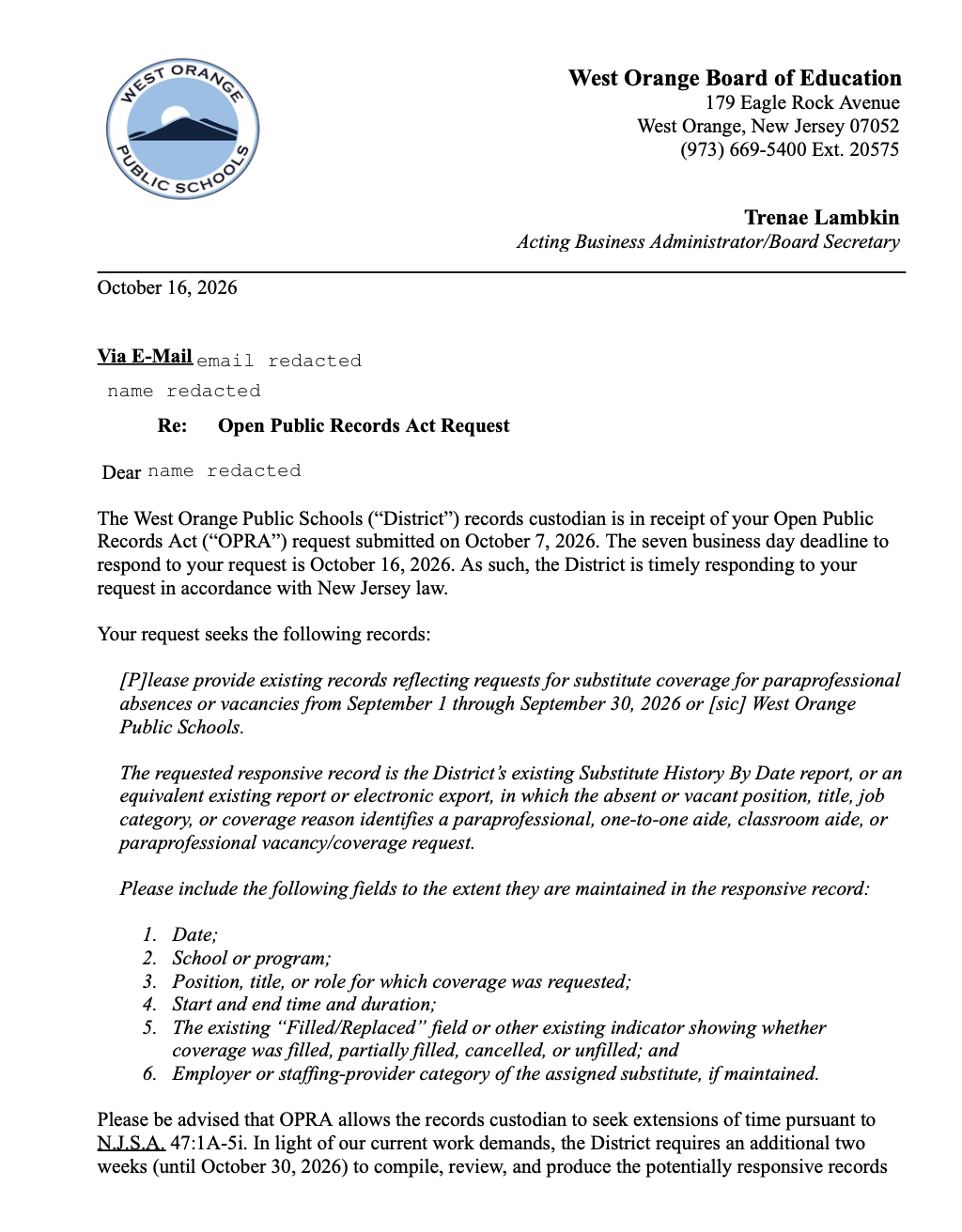
What the records show so far. Nothing published in writing. Another resident asked on October 7 for the district’s substitute-coverage report for paraprofessional absences in September; on October 16 the district took a two-week extension, to October 30 (custodian’s letter). OPRA-002, item 2, asks for daily coverage by building.
The terms offered to paraprofessionals
“Our criteria of the outsourcing of paraprofessionals includes a seamless continuation of employment here in our district, in the same schools with salary, healthcare benefits and retirement options.” (p. 3)
What the records show so far. The Board approved a Memorandum of Agreement with the West Orange Education Association “permitting the outsourcing of the paraprofessionals” on June 16 and a revised one on July 21. Both are attachments that are not posted with the minutes, and no posted document names the vendor for the paraprofessional work or sets out its terms. OPRA-001, items 1 and 3, asks for the agreements.
Longevity pay
The negotiations committee’s email of October 14, 2026 is about the teacher contract rather than the outsourcing, but it names the outsourcing as one of the year’s “painful adjustments” and makes two checkable claims about longevity pay.
“First, please understand that this is not widely provided to teachers working in other school districts across New Jersey.”
What a statewide source says. The New Jersey School Boards Association’s own magazine reported in October 2025 that “about three-quarters of districts have provided some form of longevity award”, with 74% of agreements on file for 2025-26 and 2026-27 doing so, rising to “approximately 87%” by 2028-29 (School Leader, “Trends in Teacher Contract Negotiations”, October 15, 2025).
“West Orange’s longevity bonus is currently the highest in the state with most of our eligible staff receiving roughly $10,000.00 or $12,000.00 in longevity bonuses annually.”
What the district’s own records show. The reappointment list the Board approved on May 4, 2026 gives a longevity amount for each tenured WOEA certificated staff member for 2026-27 (agenda attachments, pp. 11-32; the committee’s email links the same document). Of the 545 staff listed, 320 have a longevity amount and 225 have none. The amounts are $5,612 (86 staff), $7,221 (169), $8,840 (50), and $10,471 (12), plus three pro-rated amounts below $5,000. The total is $2,280,577.60. No one on the list receives $12,000, and twelve receive more than $10,000. The most common amount is $7,221. The tally is reproducible from the PDF with a short script that reads each amount from the column it sits under; whether “eligible staff” means something narrower than the people on this list is a question the email does not answer. Whether the structure is “the highest in the state” is not checked here. How longevity fits with the salary guide, and what the amounts were under the last agreement on the state’s public file, is on How the Pay Works.
“Salaries and benefits represent more than 70% of the district’s budget.”
What the union says. In its response of the same day, the West Orange Education Association answered that “On average, New Jersey districts spend over 80% of their budgets on salary and benefits”, linking a New Jersey Association of School Business Officials paper that says “salaries and benefits comprise 82% of a local district’s budget”, citing the Department of Education (Chapter 44, October 2025, p. 3), and described the Board’s October 5 fact-finding offer as eliminating longevity for new hires and freezing it for current staff. That is the union’s account; the Board’s email does not describe its offer, and the proposal itself is not public. Neither figure bears on longevity by itself: on the May 4 list, longevity is 3.8% of salary. The “rising costs of healthcare benefits” the email names are on the record: the medical and prescription premium rates the Board approved in June 2026 rose 11% to 27% by plan over the year before (dental rose 3%), and the budget’s employee-benefits line rose 15% (How the Health Benefits Work).